I Trusted AI With My Ideas. Then I Learned the Same Lesson I Teach About Social Media
The irony was impossible to miss
For weeks, I had been studying platform dependency: creators who built enormous audiences on Facebook, YouTube or TikTok, only to discover how vulnerable their businesses became when access, distribution or monetization changed.
The lesson kept coming back to me: never allow one failure to take everything.
Then I realized I had created my own single point of failure.
It wasn’t Facebook. It wasn’t YouTube.
It was AI.
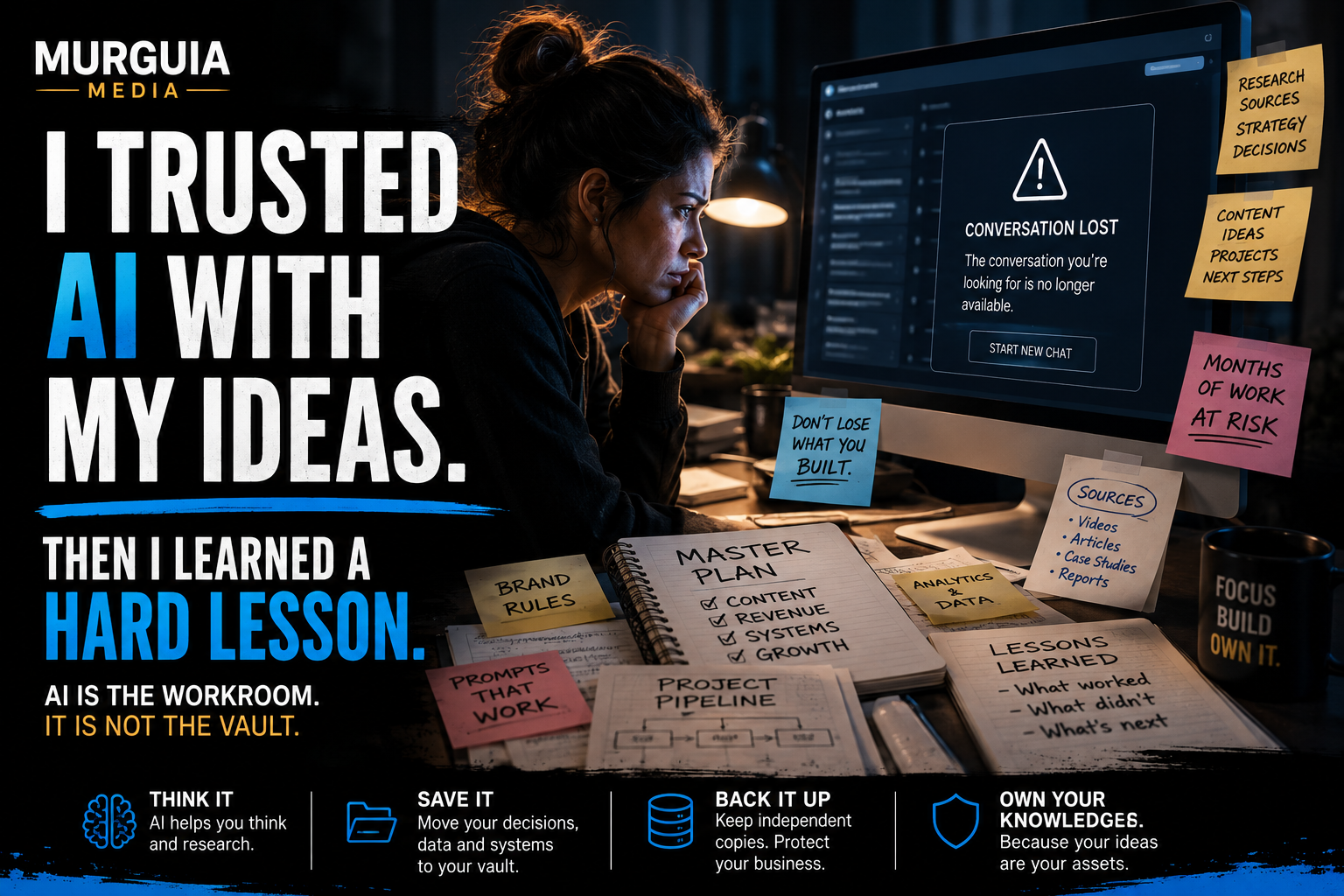
I had allowed months of research, business conversations, decisions, content strategies, project plans and ideas to accumulate inside AI conversations without consistently moving the important conclusions into a system I independently controlled.
When that continuity broke, I wasn’t worried about losing a few chat messages. I was worried about losing the thinking behind my businesses.
That is a very different thing.
AI had become part of the way I think
I don’t primarily use AI for quick questions. I use it to work.
I talk through businesses, research industries, compare opportunities, study creators, develop articles, examine monetization strategies and work through problems until something that started out scattered finally makes sense.
My thoughts don’t always arrive neatly organized. One idea reminds me of something I experienced years ago. That creates another question. That question requires research. The research changes the original idea. Eventually, after enough discussion, something usable emerges.
For me, AI has made that process considerably easier.
My hands get tired when I write for long periods. My eyes get tired. Sometimes I know what I am trying to communicate, but putting every thought into the correct order can be difficult.
Voice and AI changed that.
I can speak. Ask. Correct. Research. Reconsider. Connect ideas. Keep going until what was in my head becomes something I can actually use.
When AI understands what I am trying to build and helps me organize it correctly, that work is priceless to me.
That is exactly why I needed to protect it better.
I wasn’t storing conversations. I was storing intellectual inventory.
Think about what can accumulate inside months of serious AI work:
- Business strategies and decisions
- Research findings and source links
- Content plans and editorial calendars
- Revenue and monetization ideas
- Brand standards and operating rules
- Analytics and historical observations
- Project priorities and next actions
- Prompts and workflows that consistently work
- Ideas already tested and rejected
- Competitive research
- Articles and video concepts
- Lessons learned from previous mistakes
- Plans that may take months to implement
That isn’t casual conversation.
That is business intelligence.
And there is another part of it that is even harder to replace: context.
A search engine may help me locate a source again. I may eventually find the same article, statistic or video. What is much harder to recreate is three months of discussion explaining why that information mattered, what I connected it to, what I rejected because of it and what I ultimately decided to do.
Research can often be repeated.
Thought development cannot always be reconstructed.
EDITORIAL NOTE
This is not an anti-AI article. AI has given me tremendous value, and I intend to continue using it.
The mistake wasn’t using AI to think, research or organize.
The mistake was allowing too much finished thinking to remain inside one system.
The lesson was one I already knew
That may be the most frustrating part.
I’ve learned this lesson repeatedly in business.
Don’t depend on one customer.
Don’t depend on one marketplace.
Don’t depend on one revenue stream.
Don’t assume today’s access will exist tomorrow.
Keep reserves.
Own assets.
Create alternatives.
Build redundancy.
I understood these principles when selling products. I understood them with e-commerce. I understood them with social media. I’ve watched businesses suffer because too much depended on one source.
Yet I hadn’t completely applied the same principle to information.
Creators constantly hear that followers are rented because the platform ultimately controls access to those followers.
The same logic applies to business knowledge.
If the only usable copy of an important strategy exists inside one application, you have created a dependency whether you intended to or not.
The single-point-of-failure test
Every creator and small-business owner using AI should ask one uncomfortable question:
If this tool became unavailable tonight, what would I be unable to continue tomorrow?
Could you still answer:
- What projects are active?
- What decisions have already been made?
- What needs to happen next?
- What research has already been completed?
- Where are the supporting sources?
- What are your current business priorities?
- What content is waiting to be produced?
- What strategies have already been tested?
- What ideas were rejected and why?
- What are your current metrics?
- What are the rules for each brand?
- Where are your best prompts and workflows?
- What was supposed to be implemented this week?
If the answers exist only inside previous conversations, you don’t just have an organization problem.
You have a business-continuity problem.
Conversation is not infrastructure
This was the distinction I needed to make.
A conversation can contain your business plan without actually being your business plan.
It can contain your editorial calendar without being your editorial system.
It can contain your research without being your research library.
It can contain your analytics without being your historical record.
It can contain months of brilliant ideas while leaving you with no reliable way to see what needs to happen today.
Everything can feel organized because the AI appears to understand the history.
But conversational organization is not necessarily operational organization.
That becomes painfully obvious when the conversation is no longer available in the way you expected.
My new system: Workroom → Vault → Backup
I am not abandoning AI. I am changing where AI sits inside my business.
1. The Workroom — AI
This is where the thinking happens:
- Brainstorming
- Research
- Analysis
- Drafting
- Questions
- Comparisons
- Exploration
- Problem solving
- Messy ideas that still need development
AI is extraordinarily useful here.
2. The Vault — My business records
When something becomes important, it leaves the conversation.
The vault should contain:
- Final decisions
- Master project lists
- Research summaries
- Source links
- Content calendars
- Brand standards
- Analytics
- Approved prompts
- Business processes
- Revenue plans
- Project status
- Next actions
This is the operational version of the business.
3. The Backup — Independent continuity
The vault itself should not become another single point of failure.
Important information needs an independent backup so that one malfunction, account problem, accidental deletion or unavailable service cannot stop the business.
AI can help create the asset. It should not be the only place the asset exists.
The spreadsheet I kept trying to build suddenly became much more important
There is nothing exciting about a spreadsheet.
It doesn’t go viral. Nobody applauds because you properly documented a project. Building another idea often feels much more productive.
But a good master spreadsheet can answer questions that become extremely important when everything feels chaotic:
| The business needs to know | The master system should answer |
|---|---|
| What are we working on? | Active projects |
| What happens next? | Next action |
| What did we already decide? | Decision/history |
| What needs research? | Research queue |
| Where did the information come from? | Source links |
| What needs to be published? | Content pipeline |
| What is growing? | Current metrics |
| What makes money? | Revenue/monetization |
| What is waiting on something else? | Status/dependency |
| What can’t we afford to forget? | Must-keep notes |
That is not just organization.
That is operational memory.
And a business should not require perfect human memory to function.
Human memory is part of the risk too
Technology isn’t the only thing that fails.
People forget.
We become tired. We become overwhelmed. We move too quickly. We remember the conclusion but forget how we reached it.
Sometimes our ability to organize information changes from one day to another.
That is one reason companies document processes in the first place.
Documentation isn’t an admission that you cannot remember something.
Documentation is how a business stops requiring you to remember everything.
That distinction is especially important for solo creators and entrepreneurs because so much information exists inside one person’s head.
Your ideas belong on the asset list
Business owners know to protect tangible and financial assets:
- Money
- Inventory
- Equipment
- Domains
- Customer lists
- Contracts
- Trademarks
- Original files
But creators and knowledge businesses are constantly producing another type of asset:
Knowledge
The conclusion from three hours of research has value.
The reason you rejected a business model has value.
The prompt that finally produces the correct result has value.
The analytics that caused you to change strategy have value.
The connection you discovered between two completely different markets has value.
The lesson you learned from something that failed has value.
The context accumulated after six months of studying an industry has value.
That knowledge deserves protection too.
A simple rule for deciding what must leave the chat
From now on, I want important AI work classified into five categories:
DECISION
Something has been decided. I should not have to reconstruct the entire conversation to remember why.
DATA
Metrics, dates, analytics, financial information or numbers that may affect future decisions.
SOURCE
Articles, videos, research, documents and links supporting the work.
SYSTEM
Prompts, templates, processes, workflows and operating rules that need to be repeatable.
PROJECT
Something with an objective, status, priority and next action.
If information belongs in one of those categories, it should not remain only inside a chat.
This is bigger than ChatGPT
This lesson is not really about one company or one AI product.
It applies to ChatGPT, Claude, Gemini, Copilot, AI agents, project-management platforms, social-media management tools, cloud software and whatever comes next.
The technology can be excellent and still create business risk if we allow ourselves to become completely dependent on it.
Instead of asking only, “Is this a good tool?” business owners should also ask:
- What information exists only here?
- Can I export it?
- Do I maintain an independent copy?
- What happens if access is interrupted?
- Could I continue operating tomorrow?
- How long would reconstruction take?
- What parts of this system do I actually control?
Convenience and control are not the same thing.
AI can make us faster. It should not make us careless.
I still believe artificial intelligence represents one of the most important technological shifts of our lifetime.
I intend to keep using it.
But Gen X has lived through enough technological revolutions to recognize a pattern.
The Internet changed everything. That didn’t mean every Internet company survived.
E-commerce changed everything. That didn’t mean every marketplace seller survived.
Social media changed everything. That didn’t mean creators owned their audiences.
AI may change everything too. That does not mean the basic rules of business disappeared.
Technology changes. Business principles don’t.
- Own assets.
- Protect information.
- Document decisions.
- Create redundancy.
- Maintain reserves.
- Diversify dependencies.
- Know what you control.
- Prepare for what you don’t.
- Never allow one failure to take everything.
I learned that lesson in business long before artificial intelligence existed.
Apparently, I needed to learn it one more time.
This time with AI.
MURGUIA MEDIA TAKEAWAY
AI is the workroom. It is not the vault.
Use AI to think, research, question, organize and build. But once the work becomes valuable, move the decisions, data, sources, systems and projects somewhere you control.
Because the most valuable thing AI helps you create may not be the answer it gives you.
It may be the thinking it helped you uncover.