The Old Scam Warning Signs Don’t Work Anymore: How AI Is Making Fraud Harder to Spot
The Old Scam Warnings Don’t Work Anymore
For years, we were told we’d recognize a scam when we heard one.
The caller would have a strange accent. The email would be full of typos. The story would be far-fetched. The phone number would look wrong. Somewhere in the conversation, the scammer would slip up, and that slip would give them away.
That advice made sense when fraud was easier to spot.
It doesn’t anymore.
Artificial intelligence is quietly erasing the warning signs we’ve leaned on for decades. A scammer no longer needs to sound awkward, write badly, or know little about the person they’re targeting. Today’s criminals can combine leaked personal data, caller-ID spoofing, generative AI, and increasingly convincing voice technology into something far harder to catch.
The scammer may already know your name.
They may know your address.
They may know where you work or which bank you use.
And they may sound just as polished as the real thing.
That’s where the danger starts.
When the Details Are Real, But the Story Isn’t
Picture two everyday scenarios. In the first, someone gets a voicemail from a man claiming to be an attorney. He has the right name. He has the right address. Then comes the threat — a lawsuit. Those two correct details alone are often enough to make the fear feel justified.
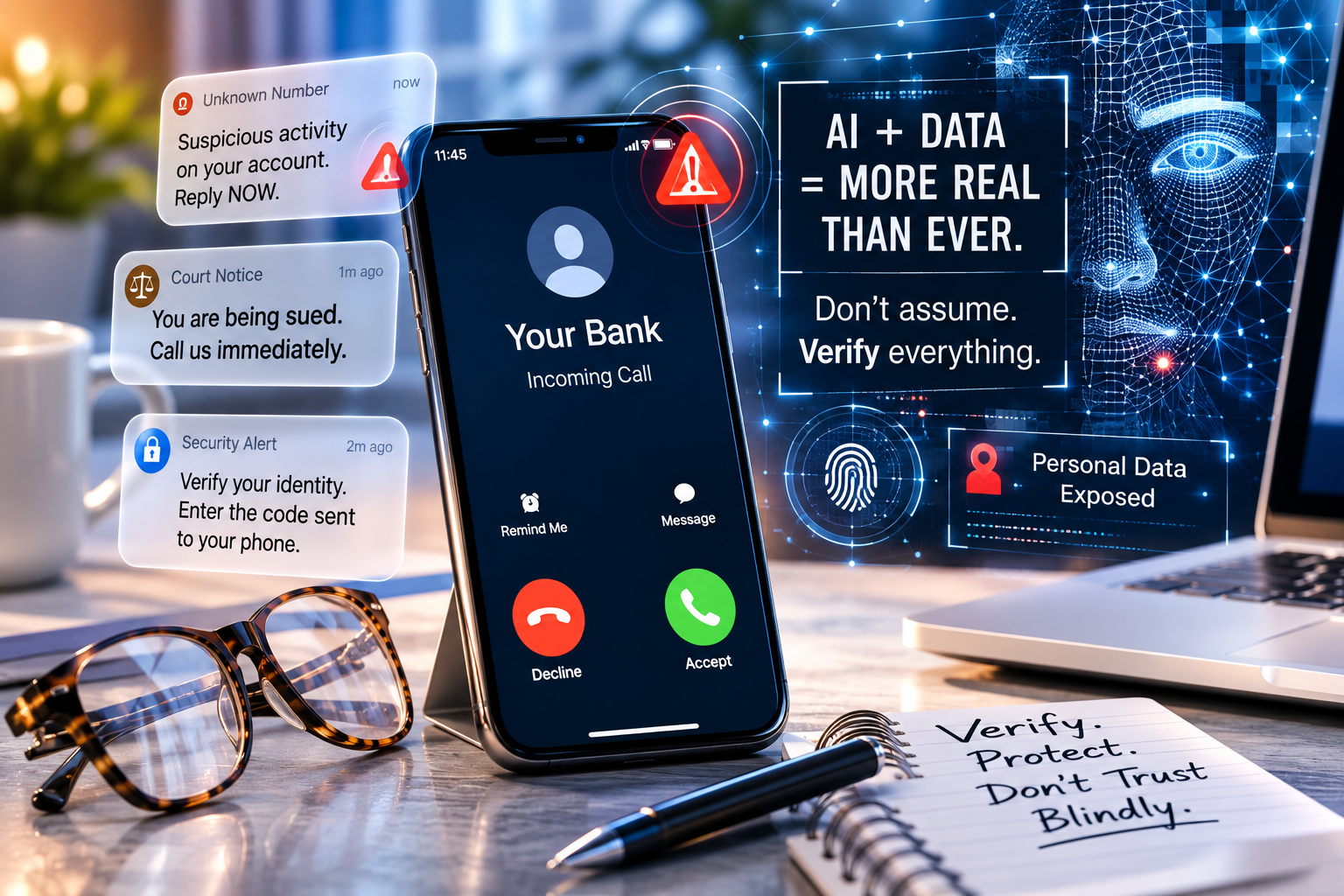
In the second, a business owner gets a call that appears to come from her bank. The man on the line sounds professional. He seems to know real details about her account. Nothing screams “scam” — until he starts asking for information her real bank would never need: a code, a login, a “verification.”
This second scenario matches a pattern the Federal Trade Commission has spent the last two years actively warning consumers about. It works like this: a text arrives asking whether you authorized a charge. You reply. Minutes later, your phone rings, and your bank’s name shows up on the caller ID. The person on the line says there’s suspicious activity and that he needs to verify your identity. A code lands on your phone.
Here’s the trap: that code may genuinely come from your real bank. The scammer may be trying to log into your actual account at that exact moment — which is why the bank’s system sends a real verification code. The criminal just needs you to read it aloud.
The FTC is unambiguous about this one: no legitimate bank employee, especially someone from a “fraud department,” will ever ask you for that code. If someone does, it’s a scam, full stop — regardless of how real the rest of the call sounds.
Caller ID Isn’t Proof, and Neither Is a Correct Name
It’s tempting to think the number looked right, so the caller must be real. That assumption no longer holds. Phone numbers can be spoofed to display a bank, a courthouse, or a government office even when the call has nothing to do with any of them. This isn’t a rare, theoretical risk — the FCC has taken direct regulatory action over it, including a proposed $4.5 million fine in April 2026 against a phone provider that let tens of thousands of fraudulent calls impersonate banks on its network.
Personal information isn’t proof of legitimacy either. Names, addresses, phone numbers, and account details have leaked in years of corporate data breaches, and more can be pulled together from social media, business listings, and public records. AI didn’t create that exposed data — but it makes it dramatically easier for criminals to organize it, personalize it, and turn it into a believable conversation in minutes.
The lie now arrives surrounded by facts. That changes everything about how we have to evaluate a call.
The FBI Has Already Warned Us About This
This isn’t speculation. In December 2024, the FBI issued a formal public alert (I-120324-PSA) stating plainly that criminals are exploiting generative AI to commit fraud “on a larger scale,” which increases how believable their schemes are. The bureau went further, noting something that should reshape how we think about warning signs altogether: these tools “assist with content creation and can correct for human errors that might otherwise serve as warning signs of fraud.”
In other words — the typos and awkward phrasing we were trained to watch for are becoming a thing of the past, and the FBI is saying so directly.
The same alert flagged AI-generated voice cloning as a specific, active threat — including audio built to impersonate a relative in crisis, asking for urgent money. This is the modern version of the classic “grandchild in trouble” scam, except now the voice itself can be convincingly faked.
The FBI’s own recommended defense against this is refreshingly simple: create a secret word or phrase with your family, ahead of time, that a scammer wouldn’t know. And when in doubt about any caller, hang up and contact the organization directly using a number you already know — not one the caller gives you.
The New Rule: Verify the Channel, Not the Person
That family “safe word” doesn’t sound paranoid anymore. It sounds practical.
The same logic extends to businesses. An employee gets a message from “the owner” requesting an urgent wire transfer. A bookkeeper receives new payment instructions. In the past, recognizing a boss’s writing style or voice might have been enough reassurance. Increasingly, it isn’t — and businesses need verification steps that don’t rely solely on whether a request “sounds like” the person sending it.
For years, scam prevention focused on identifying the scammer: What do they sound like? How do they write? What mistakes do they make? AI is forcing all of us to move past that model, because those mistakes are disappearing.
The safer question isn’t “Does this person seem legitimate?”
It’s “Can I verify this request independently, through a channel I control?”
- If your bank calls, hang up and call the number printed on your card.
- If a court or government office contacts you, look up their official number yourself.
- If a family member calls asking for emergency money, call them back on a number you already have saved.
- If your boss requests an unusual transfer, confirm it through a separate, trusted channel.
Never let the person who initiated the contact also control how you verify them.
Not “listen for the accent.” Not “look for the typo.” Not “they knew my address, so it must be real.” Those clues belonged to an earlier era of fraud.
The scammer of 2026 may sound educated. They may sound local. They may write perfectly. They may know exactly where you live and bank. They may even sound like someone you love.
None of that proves who’s really on the other end of the line.
Artificial intelligence is changing fraud. Our habits have to change with it.
Sources: FBI Internet Crime Complaint Center, Public Service Announcement I-120324-PSA (Dec. 3, 2024), “Criminals Use Generative Artificial Intelligence to Facilitate Financial Fraud”; Federal Trade Commission, Consumer Advice, “Never move your money to ‘protect it.’ That’s a scam” (March 5, 2024); Federal Communications Commission, “Bank Impersonation Scams” consumer guidance page.