Read the Numbers Before You Chase Them
Once you’ve got your boards organized and your first pins going out, the next question is how you actually know if any of it is working. This is where I see people either ignore their numbers completely, or go the opposite direction and buy every tool available before they’ve even figured out what they’re looking at.
Neither one is the move. Here’s how I actually approach it.
Start Free. Only Pay When You’re Ready to Use What You’re Buying
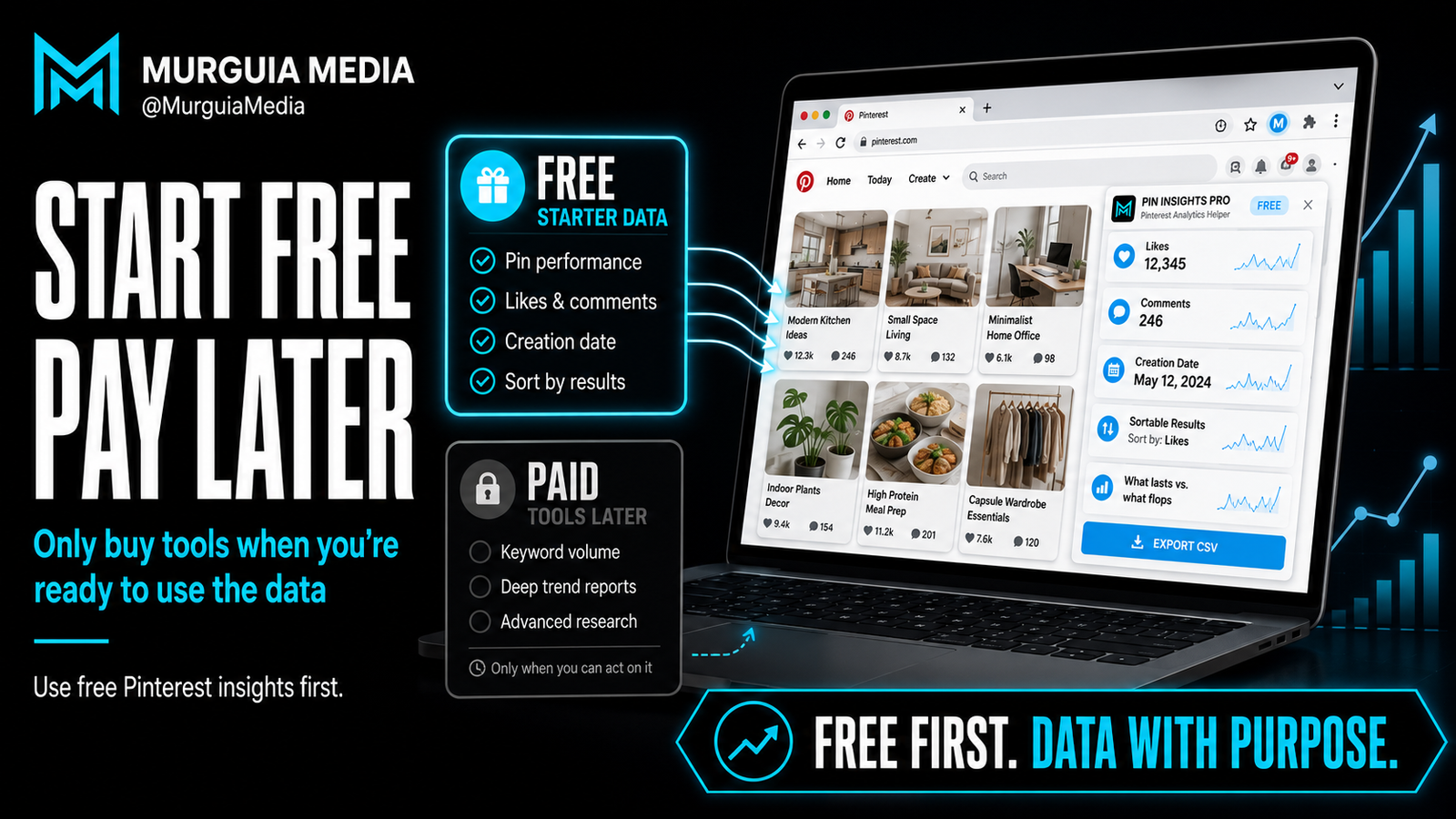
There’s no shortage of paid tools that promise deeper Pinterest data. Some of them are genuinely good. But there’s no point paying for more information than you’re actually ready to act on. If you can’t yet do anything meaningful with deep keyword volume data, buying access to it is just spending money to feel like you’re doing something.
Start with what’s free. If you’re on Chrome, there are extensions built specifically to show you Pinterest pin performance — likes, comments, creation date, sortable so you can actually see what’s holding up over time versus what flopped. That’s a genuinely useful starting point, and it costs nothing.
From there, go straight to Pinterest’s own built-in analytics. This is something people consistently sleep on. Pinterest gives you an analytics overview, audience insights, and its own trends tool, all sitting right inside the platform you’re already using. Learn to read what Pinterest is already telling you before you go looking for outside software to tell you the same thing in a different format.
What Free Tools Can’t Do — And When That Actually Matters
Depending on your platform, you’ll have more or fewer free options. Chrome tends to have a wider extension library than Safari, so that’s worth knowing if you’re choosing where to work from. And there’s a ceiling on what free tools show you — paid options exist because they go deeper, particularly around keyword search volume that Pinterest doesn’t make public anywhere else.
But that depth is only useful once you’re at the point where you can actually apply it. There’s no failure in starting with the free tools and staying there for a while. The point is matching the tool to where you actually are, not where you wish you were.
Proof That This Actually Compounds
I want to show you something real instead of just telling you this works in theory. I have an account, BeautyGenX, that I haven’t actively worked on in a while — no daily posting, no fresh content push. Right now, that account is still pulling in 2.5 million monthly views. Not because I’m doing anything active this week, but because of years of consistent, seasonal, keyword-organized pinning that’s already built into that account’s history.
That’s the actual payoff of everything covered earlier in this series — the organization, the destination-checking, the keyword research done properly from the start. It keeps paying you back long after the active work slows down. That’s not luck. That’s what compounding traffic on a search engine looks like when the foundation was built correctly.
What I’d Actually Tell You to Check
When you open your analytics, whether it’s a free Chrome extension or Pinterest’s own dashboard, here’s what’s actually worth your attention:
- Which individual pins are still generating views months or years after you posted them — that tells you what’s actually holding up, not just what got a quick spike
- Outbound clicks, not just impressions — a pin with huge views and almost no clicks is telling you something different than a pin with modest views and strong clicks
- Which boards are carrying the account, so you know where to keep investing your quiet time
Where This Leaves You
Don’t skip your analytics, and don’t overbuy them either. Free tools first. Learn to actually read what they’re telling you. Add paid depth only once you know exactly what you’d do with it. The numbers aren’t there to overwhelm you — they’re there to tell you, plainly, what’s actually working, so you stop guessing.
Next up: the last piece of this series, and probably the most important — how to think about timing realistically, so you’re not judging your own results by a calendar that was never yours to begin with.