
You Don’t Need 10,000 Followers to Get Paid — You Need a Menu
A large following can create opportunities, but follower count alone is not a business model. Smaller creators can begin earning by giving the right audience several clear ways to work with them, buy from them, or support what they create.
By Laura Murguia
For years, creators have been taught to chase the same milestone: more followers.
Reach 1,000. Then 5,000. Then 10,000. Keep posting, keep growing, and eventually the money will come.
Sometimes it does. Often, it does not.
A creator can have thousands of followers and still have no clear path to income. Another creator may have a much smaller audience but consistently earn because the people following them understand what they offer and how to take the next step.
That is the difference between having an audience and having a business.
You do not necessarily need 10,000 followers to begin earning online. You need trust, useful content, and a menu of opportunities that gives people more than one way to engage with your work.
Follower Count Is Not the Same as Buying Intent
Followers can make a page look established, but numbers do not always reflect how interested or connected an audience really is.
Ten thousand people who scroll past your content are less valuable to a business than one hundred people who regularly read, respond, click, ask questions, and trust your recommendations.
I have learned this by working across very different types of brands.
Faith content, community information, furniture marketing, home décor, and digital education do not attract the same audiences. They also do not generate income in the same way.
In furniture sales, I do not need thousands of people to respond to one listing. I need the right customer to see the right product, understand the price, know how delivery works, and feel confident enough to place an order.
One qualified buyer can be more valuable than thousands of passive views.
The same principle applies to digital content. A smaller creator can earn when the audience understands the creator’s value and is presented with a relevant next step.
What Is a Monetization Menu?
A monetization menu is simply a group of income options connected to your content, knowledge, audience, or skills.
Think about a restaurant menu. Every customer does not order the same thing. One person may want something small. Another is ready for the full experience. Someone else may only be browsing today but returns later because the options were clear.
Your digital business can work the same way.
A useful monetization menu may include:
- A product or service you sell directly
- Affiliate recommendations
- Digital downloads or templates
- User-generated content for businesses
- Brand partnerships or sponsored content
- Paid workshops, consultations, or memberships
- Platform advertising or creator-program revenue
You do not need to offer everything at once. In fact, beginning with two or three related options is usually more manageable.
The goal is to create several appropriate paths instead of depending on one platform to decide whether your work qualifies to earn money.
Start With What You Can Offer Directly
The fastest path to revenue is often not platform monetization. It is identifying something useful that you can offer directly.
A home décor creator might offer a personalized room-styling plan.
A social media creator might prepare captions, content calendars, graphics, or page reviews for small businesses.
A photographer might sell mini-sessions or branded image packages.
A creator experienced with artificial intelligence might offer a beginner-friendly workshop, prompt collection, or one-on-one setup session.
A furniture seller may use content to generate product inquiries, delivery quotes, deposits, and completed sales.
These offers do not require a platform to approve you for an advertising program. They require a real service or product, clear communication, and a simple way for customers to respond.
Your first offer does not have to be elaborate. It should solve one recognizable problem for one specific person.
Instead of saying, “I help with social media,” say:
I create a customized seven-day content plan for small businesses that do not know what to post.
That gives a potential customer something concrete to understand.
Affiliate Marketing Can Be One Part of the Menu
Affiliate marketing allows creators to earn a commission when someone purchases through a tracked referral link.
It can work well when the products naturally belong within the creator’s existing content.
A home creator may recommend lighting, furniture, organizers, or décor.
A beauty creator may recommend products they genuinely use.
A content creator may recommend editing software, microphones, tripods, website tools, or other equipment.
The recommendation should begin with usefulness—not commission potential.
An audience can usually tell when every product is being promoted only because someone hopes to make money from it. Trust disappears quickly when recommendations feel disconnected from the content or the creator’s actual experience.
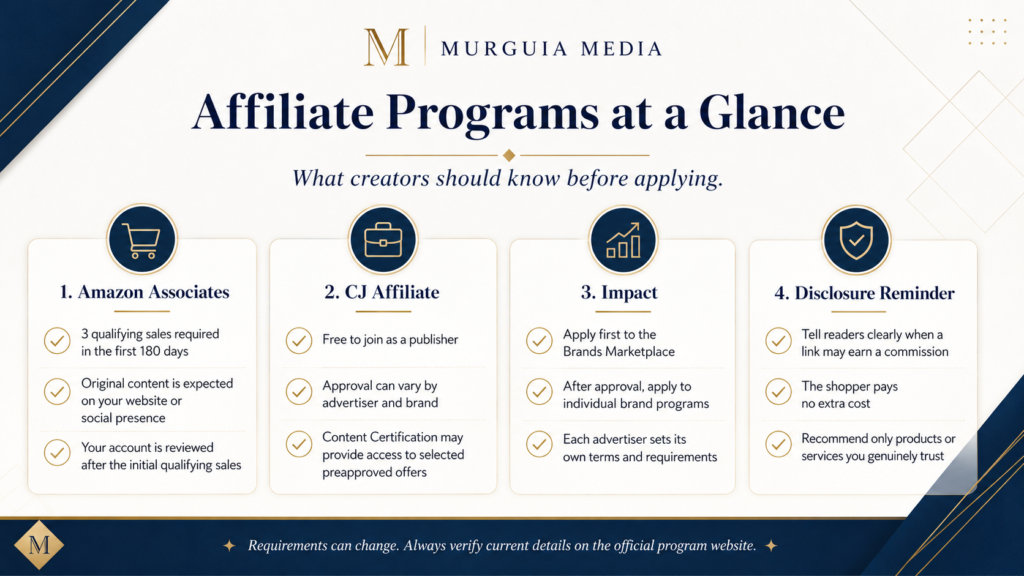
Creators must also understand that joining an affiliate network does not guarantee approval for every individual brand.
Amazon Associates currently evaluates an application after the creator generates at least three qualifying sales within the first 180 days. Amazon also reviews whether the creator’s website or social presence contains established, original content.
CJ allows publishers and creators to open an account without a joining fee, but individual advertiser relationships may still depend on the strength of the publisher’s profile, promotional channels, content, and audience. CJ also offers a Content Certification program that can provide qualified publishers with preapproved access to selected brands.
Impact requires most independent creators to apply for admission to its Brands Marketplace. After marketplace approval, creators can search for relevant companies and submit applications to individual brand programs.
Requirements can change, and every company may use different approval standards. Creators should always review the current rules on the official program website before applying.
Affiliate links should also be disclosed clearly. If you may earn money from a recommendation, the reader should not have to search for that information in fine print or on a separate page.
Create Something You Can Sell More Than Once
A service produces income each time you perform the work. A digital product can potentially be sold repeatedly after it has been created.
This does not mean every creator needs to build a complicated online course.
A digital product can be simple and practical:
- A checklist
- A short guide
- A content calendar
- A workbook
- A set of templates
- A caption collection
- A printable planner
- A tutorial
- A resource directory
The best digital products usually come from questions people are already asking.
When several people repeatedly ask how you complete a particular task, where you find information, what tools you use, or how you organize your process, that question may reveal a product opportunity.
Create the smallest useful solution first.
A focused guide that solves one problem can be more valuable than a massive course that overwhelms the customer and is never completed.
You Can Create Content for Brands Without Being an Influencer
Many creators assume that brands only work with people who have large public audiences.
That is not always true.
Businesses also need content they can publish on their own websites, advertisements, product pages, and social media accounts. This is often called user-generated content, or UGC.
In that arrangement, the creator is being paid for the content itself—not necessarily for access to a large following.
A creator may produce:
- A short product demonstration
- An unboxing video
- Lifestyle photography
- A testimonial-style video
- A voice-over tutorial
- A before-and-after presentation
- A collection of vertical clips for Reels or advertisements
The creator still needs a strong sample portfolio and must follow advertising-disclosure rules when publishing paid content. However, the opportunity is based more on the creator’s ability to communicate and produce useful content than on reaching a particular follower milestone.
This is especially important for adults entering content creation later in life. Brands need people who can speak authentically to different generations, lifestyles, needs, and buying decisions.
Every creator does not have to look or sound the same.
Platform Monetization Should Be One Income Stream, Not the Entire Plan
Advertising programs, creator bonuses, subscriptions, gifts, and platform revenue can become valuable. But they are also controlled by rules that creators do not own.
A platform can change:
- Eligibility requirements
- Payment structures
- Content policies
- Recommendation systems
- Monetization availability
- Account access
That does not mean creators should ignore platform revenue. It means they should avoid building an entire business around a single approval, bonus, or algorithm.
Platform revenue is strongest when it sits beside other options.
For example, a creator might earn from YouTube advertising while also using the same video to introduce an affiliate product, promote a digital guide, attract service clients, or bring readers to an email newsletter.
One piece of content can support several parts of the business without becoming overloaded with sales pitches.
Build a Simple Three-Level Menu
A creator’s first monetization menu can have three levels.
A Free Entry Point
This may be your social content, blog, newsletter, free checklist, or helpful resource.
The free content allows people to discover your work and decide whether they trust your approach.
An Affordable Product
This might be a template, printable, short guide, resource collection, or workshop.
It gives someone a low-risk way to become a customer.
A Higher-Value Offer
This could be a personalized service, consultation, content package, physical product, or more complete program.
Not everyone will need this level, but it creates an option for people who want direct help or a complete solution.
The three offers should feel connected.
A creator who teaches social media might provide free posting advice, sell a content-calendar template, and offer personalized content planning.
A home creator might share free decorating ideas, sell a room-planning guide, and provide individual styling assistance.
A furniture business might share room inspiration, sell the featured furniture, and offer delivery or assembly based on the customer’s location.
The content naturally introduces the next step.
Make the Next Step Easy to Find
A monetization menu cannot work when visitors do not know it exists.
A creator does not need a complicated website, but the audience should be able to answer these questions quickly:
- What does this person help with?
- What can I purchase?
- How do I contact them?
- Where can I learn more?
- What should I do next?
Your options can be displayed through a simple website page, pinned Facebook post, Instagram highlight, link page, email welcome message, or video description.
Avoid making people search through months of content to discover how to work with you.
Clarity creates confidence.
Measure More Than Followers
Follower growth is worth tracking, but it should not be the only measurement.
Pay attention to:
- Messages and inquiries
- Email subscribers
- Link clicks
- Product-page visits
- Saves and shares
- Deposits or appointments
- Affiliate conversions
- Repeat customers
- Completed sales
These actions reveal whether the content is moving people closer to a decision.
A post with fewer views may produce more revenue than a viral post if it reaches the correct audience and includes a useful offer.
That is why creators should not automatically judge their progress by visibility alone.
You Are Building an Ecosystem, Not Chasing One Number
There is nothing wrong with wanting a larger audience. Growth can increase reach, credibility, and opportunity.
But creators should not postpone every business goal until an arbitrary number appears beside their name.
You can begin learning what your audience values now.
You can create one useful offer now.
You can organize your recommendations now.
You can build an email list now.
You can show businesses what you are capable of creating now.
You can make it easier for a potential customer to take the next step now.
Ten thousand followers may eventually become part of your story, but they do not have to be the beginning of it.
A follower count tells people how many accounts clicked a button.
A well-designed menu shows people how your work can help them—and gives your creativity a real opportunity to support you.