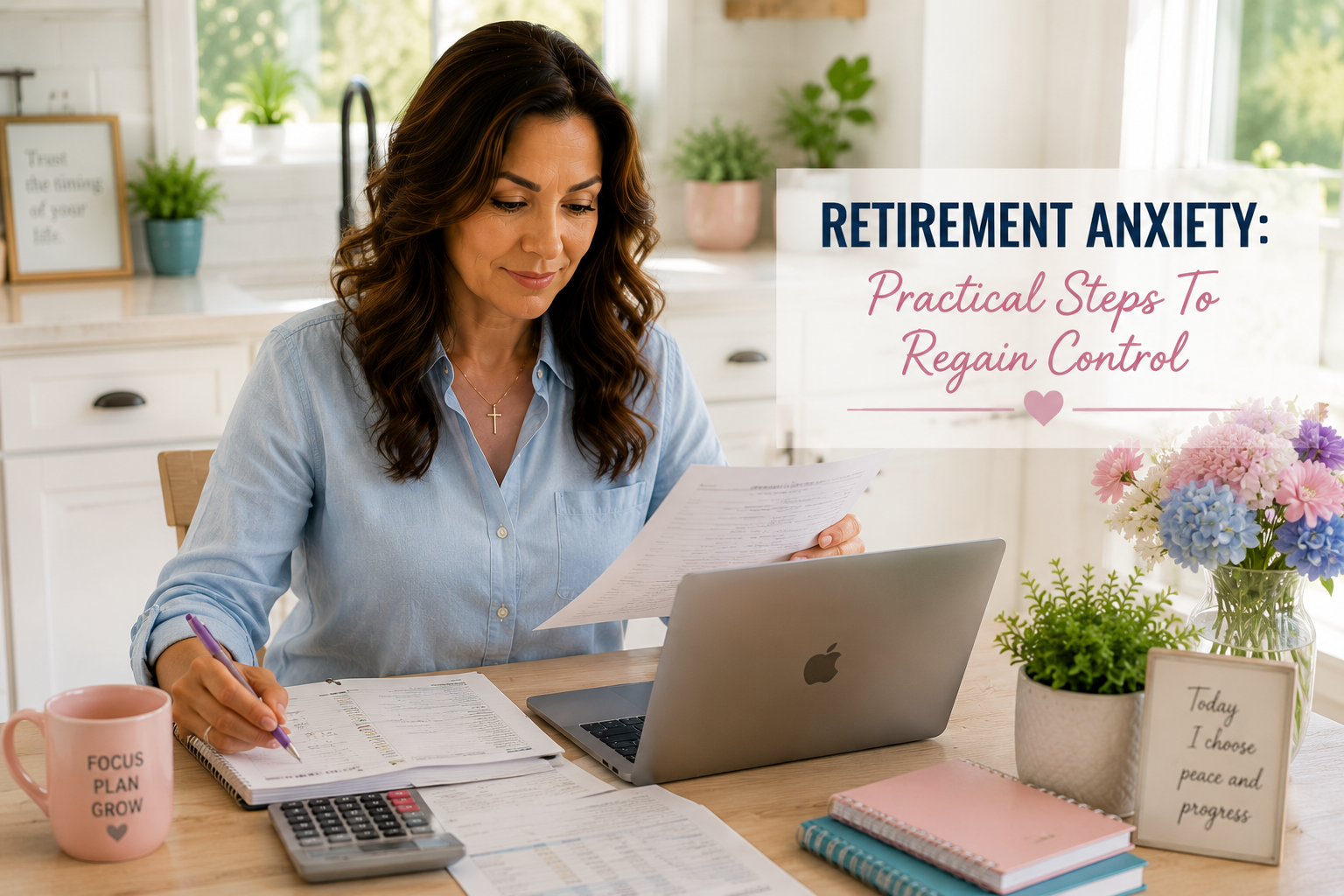
Retirement Anxiety: Practical Steps To Regain Control
Retirement anxiety isn’t just for people who haven’t saved enough. I talk to careful savers who feel it just as much, because most of the time, the fear isn’t only about money. It’s about losing your identity, running out of time, or facing the unknown without the structure of a job. Here’s the good news: this kind of anxiety responds really well to specifics. Vague fear shrinks fast once you replace it with real numbers and a real plan.
Here’s the reality: retirement anxiety usually comes from three overlapping fears — running out of money, losing your sense of purpose, and facing health uncertainty without a job to structure your days. Each one needs a different kind of solution, and I’ve noticed most people only address the first one, while the other two quietly keep the stress going in the background.
On the money fear — the single most effective thing you can do is get a specific, realistic projection. Not a guess. An actual calculation. A free retirement calculator, or one session with a fee-only financial planner, can show you in real numbers what your retirement income is likely to look like based on your savings, your Social Security estimate, and your expected expenses. Most people I talk to imagine the worst-case scenario by default. An actual projection is almost always less terrifying than what they’d been picturing in their head, even when it shows that some adjustments are needed.
Try this: write down your expected monthly expenses in retirement — housing, food, healthcare, insurance, the fun stuff — and compare it to your expected monthly income from Social Security, a pension if you have one, and a conservative withdrawal from savings. If there’s a gap, that gap is now a specific number you can actually work with — by working a bit longer, adjusting your retirement date, trimming planned expenses, or saving more. That’s a much more manageable problem than a vague cloud of dread.
On the identity and purpose fear — this one gets underestimated constantly, especially for people whose careers were a big part of who they are. The fear isn’t always “will I have enough money.” Sometimes it’s “who am I without my job title.” I’d address this before you retire, not after. Think about what actually gave your work meaning — was it solving problems, mentoring people, being needed, the structure, the social connection — and find one or two ways to keep that going outside of work. Volunteering, part-time consulting, mentoring someone coming up in your field, getting involved locally.
Many people I talk to who handled this transition well started building that structure before they actually left their job — not after. By the time they walked away, they already had somewhere to put that energy, which made the whole shift feel a lot less disorienting.
On the health uncertainty fear — healthcare costs are one of the most underestimated parts of retirement. Look up current estimates for healthcare costs in retirement (these change every year, so get a current figure) and build that into your plan directly, instead of just assuming Medicare will cover everything. Understanding what Medicare actually covers, and whether a supplemental policy makes sense for you, removes a lot of the “unknown” that fuels this fear.
One thing I’ve learned: retirement planning isn’t one giant decision you make and walk away from. It’s a flexible plan you revisit every year or two as life changes. Treating it like a single make-or-break moment is exactly what creates the paralysis. Treating it as something you check in on regularly is what actually gives you control.
Action Steps:
- Get one real, specific retirement income projection from a free calculator or a fee-only planner this month.
- Write out your expected monthly expenses versus expected income to find your actual gap, if there is one.
- Identify one non-financial source of purpose or structure to build before you retire, not after.
- Look into what Medicare actually covers and whether supplemental insurance makes sense for your situation.
Retirement anxiety almost always shrinks once you replace it with specifics — a real number, a real plan, a real next step. You don’t need certainty to feel in control. You need clarity, and that’s something you can start building today.