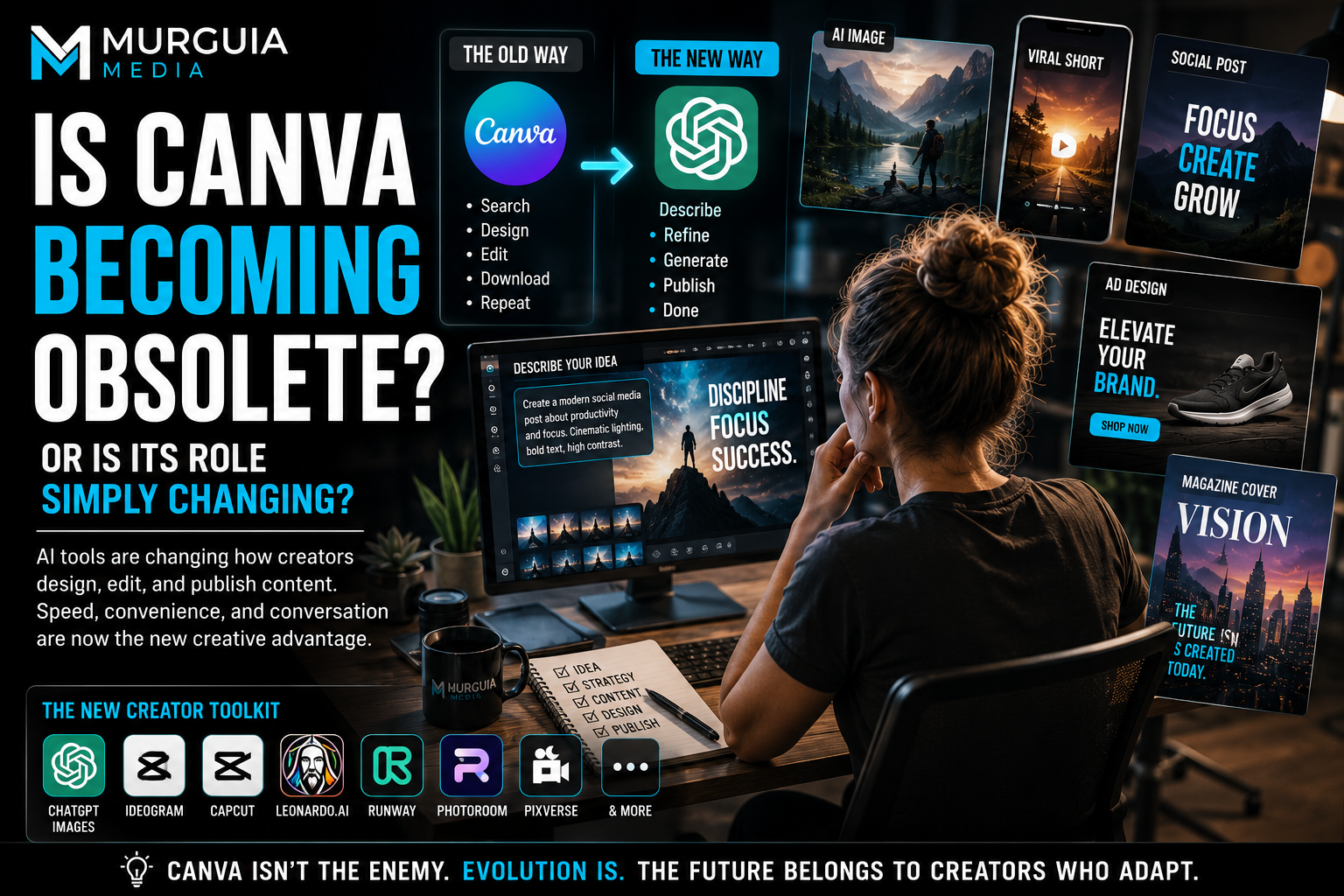
Is Canva Becoming Obsolete—or Is Its Role Simply Changing?
A social media post recently declared it was time to say goodbye to Canva and expensive editing applications. It offered ten ChatGPT prompts designed to transform ordinary photographs into advertisements, magazine covers, thumbnails, branded posters and enhanced social media graphics.
The headline was effective. It immediately captured the frustration many creators feel after paying for multiple applications and spending hours manually assembling content.
But is Canva truly becoming obsolete?
Not exactly.
What is becoming obsolete is the assumption that every creator must begin with a blank canvas, search for individual elements and manually construct every visual before publishing it.
The Prompts Are Helpful, but They Are Not Magic
The prompts in the post provide useful creative instructions. They ask AI to improve lighting, sharpen details, create visual hierarchy, separate a subject from the background and produce a more professional composition.
However, instructions such as “make this viral,” “create agency-quality work” or “keep the person’s identity completely unchanged” cannot guarantee those outcomes.
AI still makes errors. It may alter facial features, distort small details, misspell text or produce a design that is visually impressive but poorly suited to the creator’s audience.
A prompt is only the beginning.
The creator must still recognize when the image is wrong, explain what needs to change and continue directing the process until the visual supports the message.
That is why the valuable skill is not owning a list of prompts. It is developing creative judgment.
Why Conversational AI Has Changed My Workflow
For my own content, the advantage of ChatGPT is not simply that it can generate an image.
The advantage is that the entire idea can be developed through a conversation.
I can begin with a topic, explain what I want people to feel, refine the headline, determine the platform format and then create the visual. When something is incorrect, I can explain the problem in ordinary language instead of manually rebuilding the complete design.
Current ChatGPT image tools are designed to follow detailed instructions, render denser text more accurately and make targeted edits while preserving important parts of the original image. Those capabilities make the system useful not only for generating artwork, but for developing practical social media graphics and marketing visuals.
That does not mean every image should have an obvious AI appearance.
A creator still needs to vary the composition, lighting, subjects, typography and visual direction. Without that direction, generated content can become repetitive and recognizable as generic AI work.
The tool creates.
The creator decides.
Where Canva Still Has an Advantage
Canva remains extremely useful for people who want direct, hands-on control over their designs.
It offers editable layouts, stock photography, fonts, templates, brand kits, background removal, resizing, content scheduling and collaborative workflows. Canva’s current U.S. Pro plan is listed at $144 per year for one person, while its free plan still includes a large template and media library.
For someone designing presentations, printed materials, brand packages, advertisements or coordinated campaigns, those tools can justify the price.
Canva also solves a problem that remains difficult for many image generators: every element can be individually selected, moved, recolored, resized or replaced.
A flat AI-generated image may look complete, but correcting one word or moving one object can sometimes require regenerating the entire design. A structured Canva file gives the user much greater control.
That difference matters.
Canva Is Not Ignoring the AI Threat
It would not be accurate to say Canva has stopped evolving.
In 2026, Canva announced Canva AI 2.0, which it describes as a conversational platform capable of generating layered, editable designs from a prompt. Its new system is designed to maintain context, apply brand styles and allow individual elements to be changed without rebuilding the entire design.
Canva has also introduced offline creation, expanded professional design capabilities through Affinity and added broader connections with creative and productivity tools.
Most importantly, Canva is beginning to meet creators inside the AI tools they already use. It has announced Magic Layers inside assistants including ChatGPT and Gemini, allowing generated visuals to be converted into editable Canva designs.
That tells us Canva understands the shift.
The company is no longer competing only with Adobe, presentation software or traditional editing tools. It is now competing with a conversation.
Ideogram and Specialized AI Tools Add More Pressure
Canva is also not competing with ChatGPT alone.
Ideogram has established itself as a strong option for posters, logos and graphics that require typography. Its current tools emphasize clearer text rendering, prompt fidelity, style control, background removal and editable visual workflows.
But specialized tools introduce another challenge: the creator may still need help developing the concept and writing the prompt.
That is why a conversational assistant can become the center of the workflow. It can help determine the message and art direction before the creator sends the final instructions to another platform.
The competition is no longer simply about which application generates the prettiest picture.
It is about which system understands what the creator is trying to accomplish.
The Subscription Question
Independent creators are now being asked to pay for writing assistants, image generators, video editors, animation tools, music platforms, scheduling services and design applications.
Every subscription must earn its place.
Canva may still provide tremendous value to a designer who uses its templates, stock library, Brand Kits, presentations, resizing and collaboration tools every day.
For another creator, however, paying for Canva may feel less necessary when ChatGPT can help develop the idea, write the copy and generate a nearly finished visual in the same conversation.
The value depends on the workflow—not on which company has the loudest marketing.
Canva May Become the Finishing Tool
Canva’s greatest threat may not be that creators abandon it completely.
The greater threat is that Canva stops being the place where the creative process begins.
A creator may develop the strategy and copy in ChatGPT, generate visuals through ChatGPT or Ideogram, edit the video in CapCut and open Canva only when a final adjustment or editable layout is needed.
In that workflow, Canva remains valuable—but it is no longer the creative center.
That is the real transformation taking place.
The Creator Is Still the Most Important Tool
AI has reduced the technical barrier between having an idea and showing it to the world.
It has not eliminated the need for judgment.
Someone must still decide whether the image communicates the correct emotion, whether the typography is readable, whether the claims are accurate and whether the final design fits the brand.
Canva is not obsolete.
But the old workflow—where creators had to manually construct every element before their idea could become visible—is rapidly losing its hold.
The future will probably not belong exclusively to Canva, ChatGPT, Ideogram or any single platform.
It will belong to creators who understand the strengths of each tool and know when to use them.
Canva may survive by becoming more intelligent, more connected and more flexible. But it can no longer assume it will always be the first place creators go when they are ready to bring an idea to life.
Want a closer look at where AI marketing tools fit into a real content workflow? Browse the Marketing category in our AI Tool Directory →