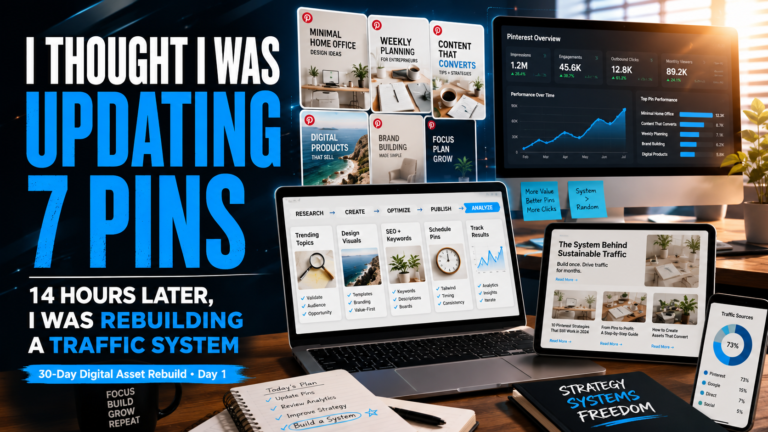
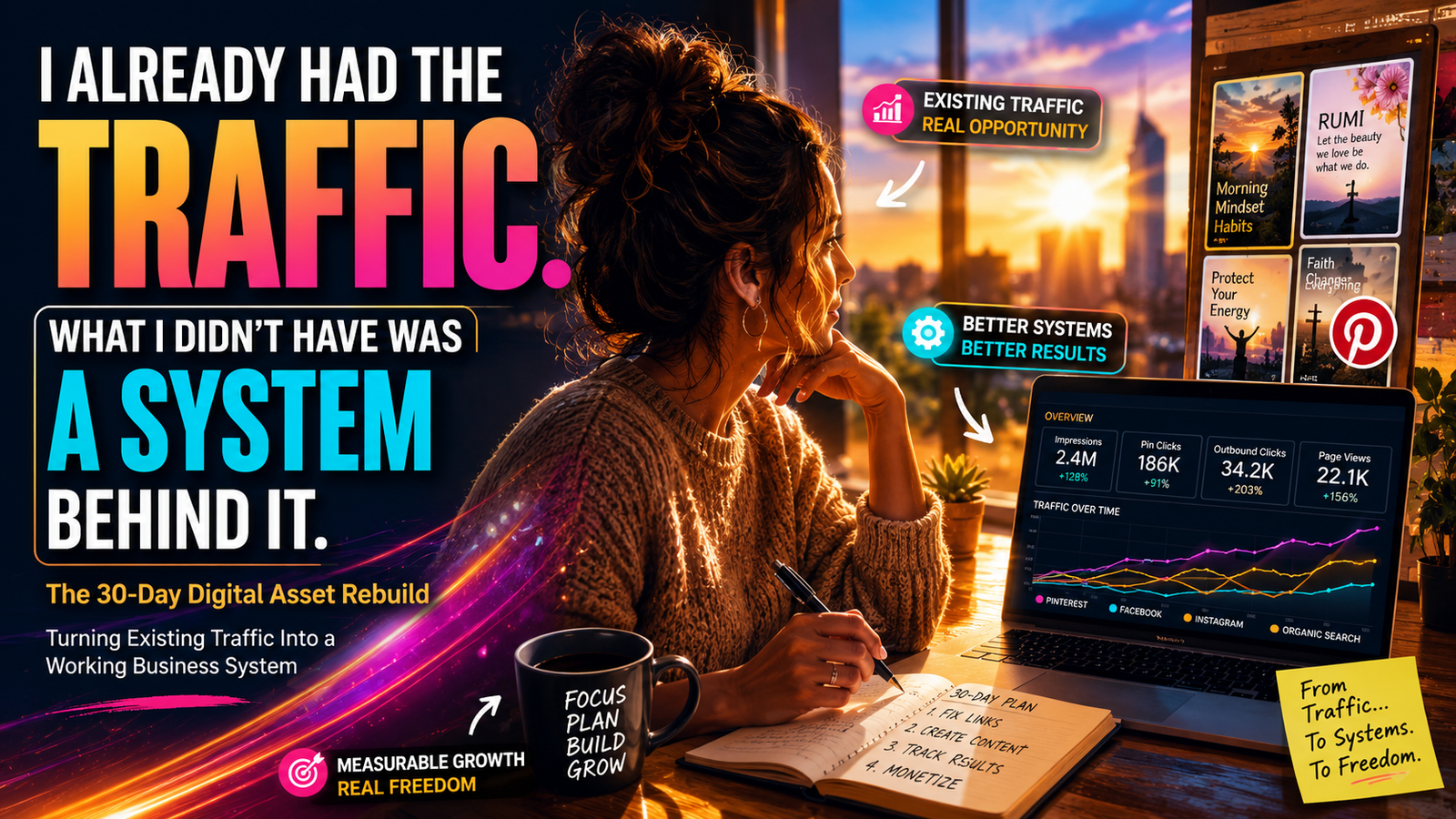
I Already Had the Traffic. What I Didn’t Have Was a System Behind It.
For a long time, I thought one of my biggest online business problems was traffic.
Today, while going through some of the digital properties I have built over the years, I realized that wasn’t entirely true.
In many cases, I already had the traffic. What I didn’t have was a reliable system behind it.
I have Pinterest accounts with years of history, websites filled with content, Facebook and Instagram pages, affiliate relationships, old articles, and Pins that continue to circulate long after I created them.
Some of those assets have been neglected as I moved from one opportunity to another, but neglected does not necessarily mean dead.
A surprising amount of that content is still being discovered.
The problem is that some of the traffic has been arriving at destinations that no longer make sense.
That is where this 30-day experiment begins.
I’m Not Starting From Zero
There is an important difference between building an online business from scratch and rebuilding digital assets that already exist.
Someone beginning today may have no website, no audience, no Pinterest history, no content library, and no information yet about what people will respond to.
My situation is different.
I already have years of accumulated digital property, but much of it was created during different stages of my business life.
Over the years, I have sold furniture, sold products through Amazon, used resale platforms, built blogs, developed social media pages, experimented with affiliate marketing, and created content across several niches.
Some projects became businesses.
Others made sense for a season and eventually stopped receiving my attention.
Still others continued quietly working in the background even when I was no longer actively managing them.
Pinterest is a perfect example.
BeautyGenX currently reaches millions of people through Pinterest, yet when I began looking more carefully at individual Pins today, I found something that exposed a much larger problem.
Some Pins were still generating impressions, clicks, and saves, but the destinations behind them had not kept up with the traffic.
People were still showing up. I simply had not built the right path for them once they arrived.
When an Old Pin Is Still Working
One of the first Pins I reviewed today was built around a Rumi quote.
It had approximately 1,860 impressions, 199 Pin clicks, and 10 saves.
Those are not extraordinary viral numbers, but they are meaningful because the Pin is old and people are still finding it.
There was only one major problem:
It linked to an Instagram account that no longer exists.
Deleting the Pin would have destroyed something Pinterest already understood.
Rewriting the title, changing the description, or replacing the creative could also interfere with a piece of content that was still attracting interest.
So instead of changing everything, I changed the part that was actually broken.
I changed the destination.
I created a new BeautyGenX article about Rumi, love, loneliness, and healing, then redirected the existing Pin to that article.
The visitor journey changed immediately.
Before: Pinterest → dead destination
Now: Pinterest → relevant article on a website I own
That one correction completely changes the value of the traffic.
Now, the article can generate advertising revenue, introduce the reader to related content, create future affiliate opportunities, and become part of a larger internal content network.
The Pin itself did not need to be reinvented.
The infrastructure behind it did.
The Pattern Repeated
The next Pin told essentially the same story.
It focused on morning mindset, abundance, and protecting your energy.
The existing Pin had approximately 2,680 impressions, 186 Pin clicks, and 29 saves.
Again, the creative already had history and engagement, so there was no reason to redesign something people were still responding to.
Instead, I created a new BeautyGenX article called:
7 Morning Mindset Habits to Protect Your Energy and Start the Day Positively
The article matched the intention behind the Pin, and the Pin was updated to send readers directly to that content.
This time, I also added UTM tracking.
That is a small technical change with a much larger purpose.
I do not want to finish this 30-day experiment saying Pinterest “seemed” to work.
I want to know.
I want to know which Pin sent traffic, which article received it, and eventually whether that traffic contributed to page views, advertising revenue, affiliate activity, or other measurable behavior.
Guessing is not a strategy. Tracking gives the strategy something to stand on.
The Same Problem Existed on Asking Him
A third example came from Asking Him.
An older Christian worship Pin had generated more than 2,000 impressions and over 200 Pin clicks, yet its destination was simply the Asking Him homepage.
Someone could see an image about worship, feel moved enough to click, and then arrive at a general homepage instead of content that continued the exact subject that caught their attention.
So I created an article specifically about Christian music, collective worship, prayer, and the experience of gathering together in faith.
The existing Pin now leads directly to that article.
Again, the principle was the same:
Preserve what is already attracting attention and repair what happens after the click.
That distinction is becoming one of the central lessons of this project.
Traffic and a Traffic System Are Not the Same Thing
For years, I looked at impressions, views, and clicks as evidence that something was working.
They are important signals, but today I am looking at them differently.
Traffic by itself is not a system.
A Pin can receive thousands of impressions and still produce very little business value if the destination is wrong.
A website can receive visitors and still waste them if the content does not lead naturally to another article, an affiliate recommendation, a product, an email relationship, or some other meaningful next step.
That does not mean every visitor must immediately be monetized.
It means the infrastructure should make sense.
If someone clicks because they are interested in Rumi, they should arrive at Rumi content.
If they click because they are interested in Christian worship, they should arrive at an article about worship.
If they click a Pin about protecting their energy, the destination should fulfill that promise.
The idea is simple. Executing it across years of accumulated content is not.
Content Does Not Always Move Immediately
Something else happened today that reminded me not to judge content too quickly.
A Versos y Fuerza post we published several days ago initially received very little response.
Then, almost three days later, people suddenly began commenting.
They were not leaving generic reactions.
They were sharing personal experiences, talking about family members, expressing sadness, and recognizing themselves or someone they loved in the message.
The post had not necessarily failed during those first quiet days.
It simply had not yet reached the people who connected with it.
Sometimes the post that looks like it failed simply hasn’t reached the person who needed it yet.
There is a business lesson in that as well.
Older content should not automatically be discarded simply because it did not explode when it was published.
Some pieces accumulate value slowly.
Others disappear and resurface months or even years later.
Pinterest, perhaps more than most social platforms, makes that particularly visible.
The Work Behind the “Simple” System
There is another reality I want to document accurately:
This work is not effortless.
I have watched plenty of content about creating dozens of Pins quickly, batching weeks of material in an hour, or building automated systems that supposedly require very little maintenance.
There is value in batching and automation once a process is established.
But building the underlying system is different from operating one that is already finished.
In roughly two hours today, I did not create dozens of new Pins.
I reviewed existing content, studied individual performance, identified broken or weak destinations, created new articles, updated links, added tracking, preserved content that was still working, and began documenting the process so I can measure the results later.
That is not wasted time.
That is infrastructure.
If the process becomes faster later, it will be because the structure was built properly first.
What I’m Testing Over the Next 30 Days
This experiment is not about proving that Pinterest works.
I already know Pinterest can generate enormous reach.
BeautyGenX alone has accumulated millions of monthly impressions without the level of consistent attention I could have been giving it.
The question is:
What happens when that existing reach is finally connected to a deliberate website strategy?
BeautyGenX gives me one type of test because it already has significant Pinterest distribution.
GlamStyleDecor provides another because it has a smaller Pinterest footprint but has historically generated stronger advertising revenue per visitor.
Asking Him offers yet another case because I have already seen how quickly social traffic can move when faith-based content connects emotionally with an audience.
Rather than treating all three properties as identical, I want to learn from their differences.
Over the next 30 days, I will be repairing outdated destinations, creating relevant articles behind Pins that already show signs of demand, improving internal linking, organizing Pinterest boards more intentionally, publishing new content, adding proper tracking, and measuring what happens to website traffic and monetization.
Eventually, I also want to compare those existing properties with a new project that starts without years of Pinterest history.
That will allow me to separate what can be accomplished by rebuilding an existing digital asset from what happens when someone genuinely begins at zero.
For now, however, the priority is the property I already own.
The Question I Want Answered
By the end of this experiment, I want more than increased traffic.
I want information.
I want to know which older Pins were worth repairing, which subjects generated real outbound clicks, which articles held a visitor’s attention, which websites produced the greatest value per visitor, and how much difference a properly connected content system actually made.
I also want to know what was not worth the effort.
If something works, I will document it.
If something fails, that belongs in the case study too.
A useful business experiment is not one where every result looks impressive.
It is one where the results teach you enough to make a better decision the next time.
That is why I am documenting this while I am doing it instead of trying to reconstruct the story six months from now.
The first lesson arrived sooner than I expected:
I may not need to begin by chasing more traffic. I may need to become much better at using the traffic I already earned.
That is where the 30-Day Digital Asset Rebuild begins.