Get Organized Before You Have Proof, Not After
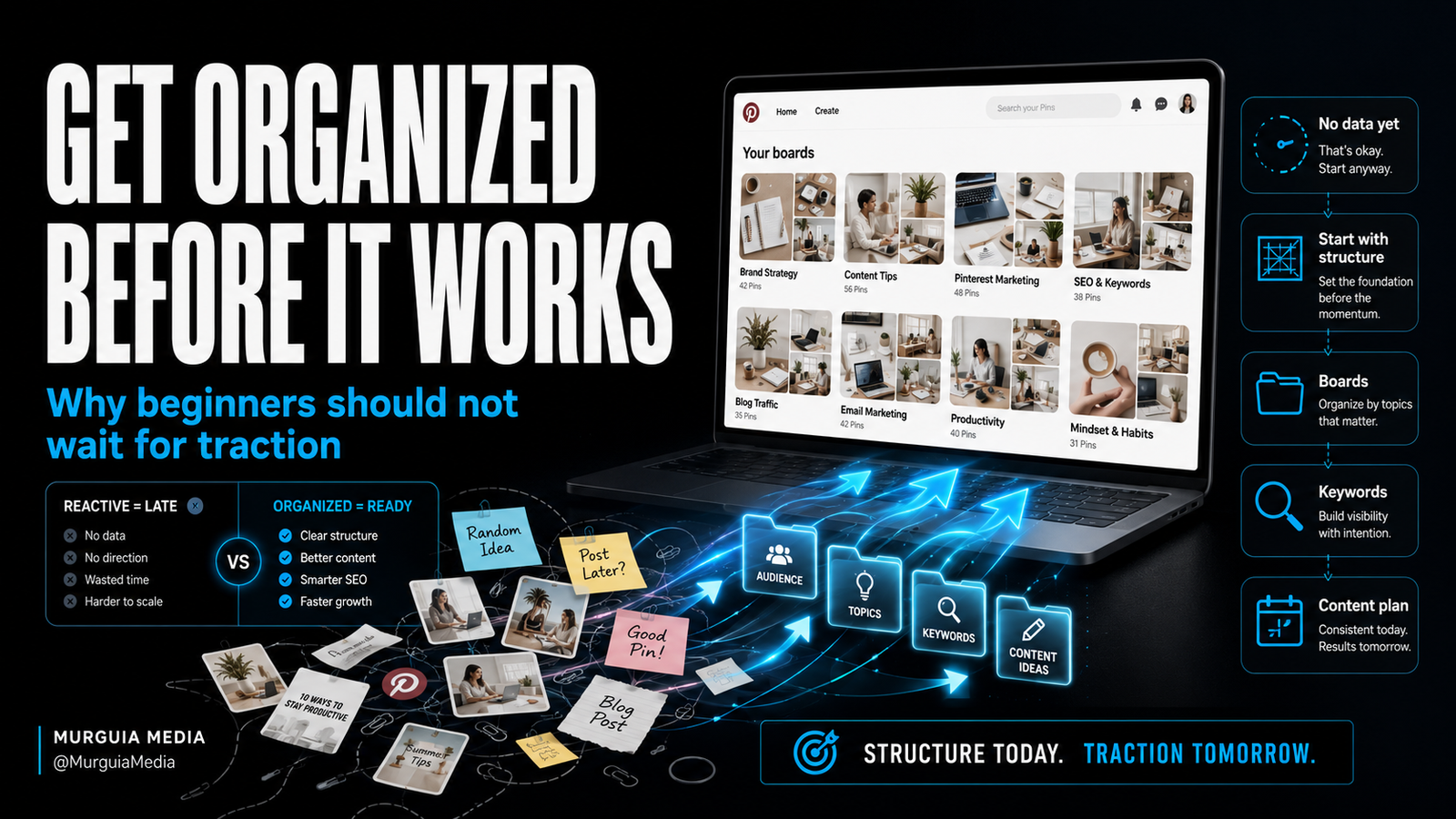
There’s a piece of advice floating around that sounds smart until you actually think it through: wait until something’s working, then get organized around it. Build the board after you get the sale. Focus once you see traction.
I understand where that comes from. But if you’re just starting out, that advice will cost you time you don’t get back.
Reactive Organization Only Works If You’ve Already Been Building
Waiting for proof before you organize makes sense for someone who already has years of pins, boards, and search history behind them. They have enough data flowing in that reacting to what’s already working is a legitimate strategy. But if you’re brand new, you don’t have that data yet. There’s nothing to react to. Telling a beginner to “wait and see what takes off” just means they drift for months with no structure at all, hoping something sticks.
Here’s the truth: get organized now. Not because you’ll never be able to change it later — you can adjust plenty — but because starting scattered means you’re rebuilding from a mess instead of refining something that already has a shape.
What You Can Change Later — And What You Really Can’t
I need to correct something people assume about Pinterest, because it matters a lot more than it sounds like it should: your board name, your board description, your cover image — those you can go back and adjust anytime. Rearranging boards, updating descriptions, swapping covers, all fair game.
But the actual link on a pin is a different story. Once a pin has been live and collecting engagement, Pinterest is generally not going to let you casually swap out the destination link. Pinterest has been slowly loosening this over time, but it’s still far from simple — and if they do let you change it, they will warn you first that you’re about to lose all of that pin’s accumulated metrics. Every view, every save, every bit of history that pin built up gets wiped the moment you change where it points.
That’s exactly why getting your destination right before you publish matters so much more than people realize. This isn’t a “fix it later, no harm done” situation. It’s a “get it right the first time, or start over from zero” situation.
A Real Example of Why This Matters
I’ll tell you exactly what happened to me, because it’s the clearest lesson I can give you. One Christmas, I pinned a DIY gift idea — a home toolkit — and it went viral. Over a million views in a single month, off of one pin. Half a million outbound clicks, all headed to an Amazon listing.
Then the listing died. The seller’s inventory ran out, the listing went inactive, and because that product ID gets tagged to that specific seller, it can’t just get reused or reactivated by someone else. So all that traffic — a million views, half a million clicks — was suddenly pointing at nothing. And because of how Pinterest handles link changes, I couldn’t just swap in a new, live link and keep the momentum going the way you’d hope.
The lesson isn’t “don’t link to Amazon.” It’s this: whatever you’re linking to, check that it’s actually going to still be there. A listing that could sell out, get delisted, or change hands isn’t a permanent destination — and if your pin takes off, you want it sending people somewhere that’s still standing months or years later.
Look at Other Creators In Your Space — Not to Copy, to Calibrate
As you’re building this out, go find other people in your specific niche. If you’re into bird watching, go find another bird watcher’s account. Look at what they’ve built — how many boards, how they’re organized, what their monthly views look like. That’s not about copying anyone. It’s about calibrating your expectations against a real account in your actual category, instead of a general number that doesn’t mean anything specific to your niche.
This matters because Pinterest numbers vary wildly by niche and by how long an account’s been active. What looks like “a lot” of traffic in one space might be nothing in another. You need a comparison point that’s actually relevant to what you’re building.
Don’t Sleep on Instagram As a Second Search Engine
Here’s a connection worth making early: if you’re already comfortable on Instagram and Pinterest still feels new, you don’t have to choose one or the other. You can connect your Instagram account so your content feeds into Pinterest automatically. That means the same post is now living in a social media platform and a search engine at the same time — Instagram getting you the social discovery, Pinterest getting you the long-term search traffic. It’s one more reason not to think of these platforms as separate, competing chores. They can genuinely work together.
What a “Lost Pin” Actually Looks Like
I want to walk you through this because I’ve lived it, more than once. A lost pin is a pin that gets views — sometimes a lot of them — but goes absolutely nowhere for you, because something basic is missing:
- No website name anywhere on the image
- No link filled in where Pinterest gives you the option
- Inconsistent or missing branding, so even if someone likes it, they have no way to find you again
- A link that pointed somewhere solid once, but doesn’t anymore — like my Christmas toolkit pin
I currently run several different Pinterest accounts. A few of them send me real, consistent traffic. The rest could be doing so much more, and the difference isn’t the niche or the content quality — it’s that the organized ones had their branding, their links, and their destinations locked in and verified from the start, and the others didn’t.
A pin with thousands of views and no name on it, no working link, is functionally invisible to your business. It fed the algorithm. It didn’t feed you.
Where This Leaves You
Get your board structure in place before you post your first pin. Know your keyword. Put your name or website on every image. Fill in the link every single time, and double-check that whatever you’re linking to is actually going to last. None of that locks you into your board setup forever — but your pin links are a different matter, so treat that decision like it’s permanent, because in practice, it mostly is.
Next up in this series: why “finding time” for Pinterest is the wrong way to think about it entirely — and what to actually pay attention to instead.