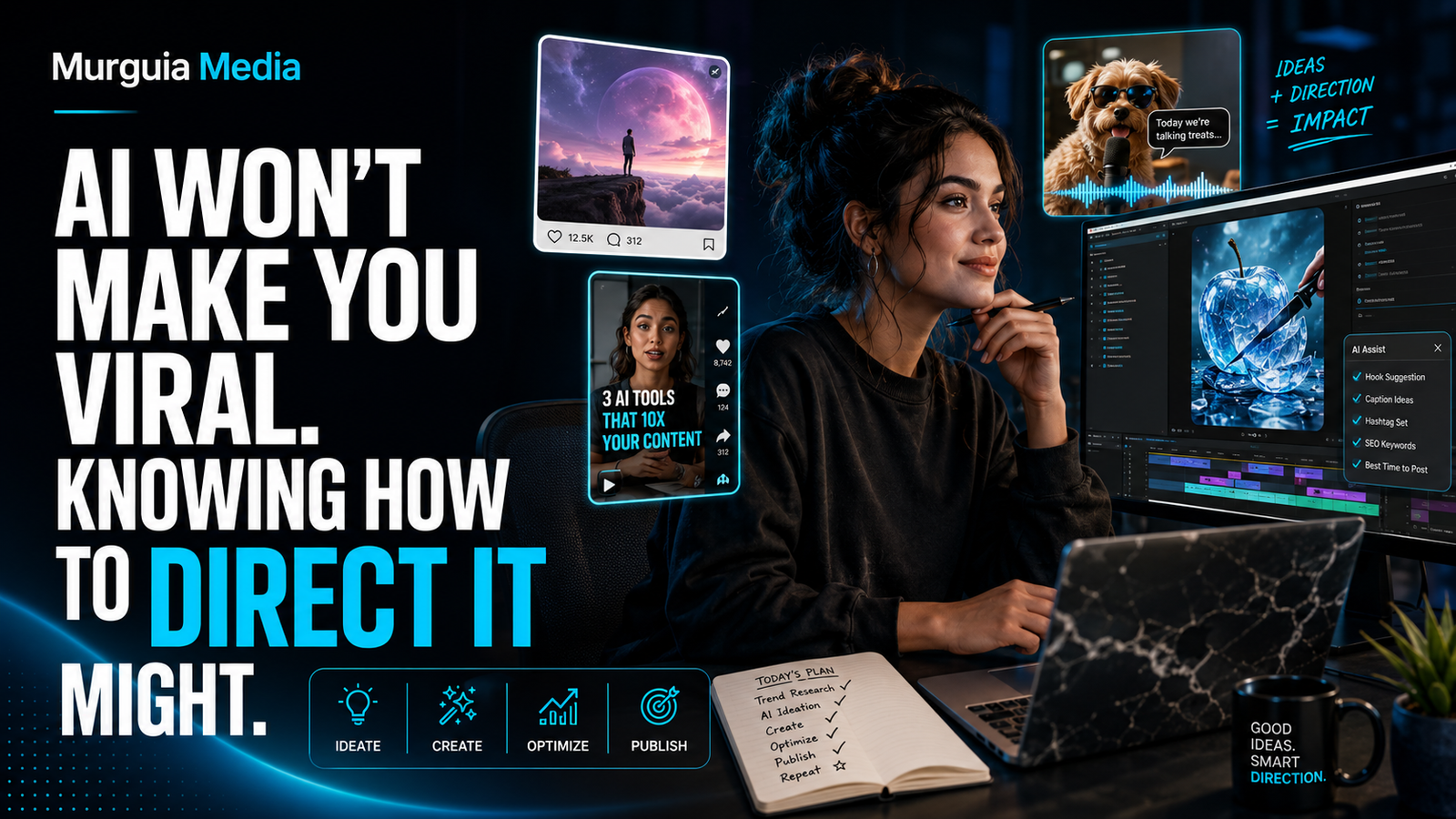
AI Won’t Make You Viral. Knowing How to Direct It Might
The new creator advantage is not simply having access to artificial intelligence. It is knowing how to turn an idea into something people will stop to see.
AI has completely changed the way I create content.
Not because it creates every idea for me. Not because I can press one button and automatically go viral. And certainly not because the technology gets everything right the first time.
AI has changed my work because it allows me to take an idea that exists only in my mind and make it visible.
Before these tools, creating one visual post could mean searching for several photographs, arranging them into a collage, removing backgrounds, choosing fonts, resizing everything, correcting the text and spending far too much time inside a design program.
I could learn to do all of that manually. But when your goal is to build several brands, publish consistently and eventually monetize your content, every hour spent manually assembling one graphic is an hour you cannot spend researching, writing, developing another idea or building the business.
That is where AI becomes valuable.
AI Gives Independent Creators Leverage
A creator can describe the scene, emotion, audience, format, lighting, colors, composition and message—and then continue refining the image until it supports the original idea.
That last part matters.
The quality of the result depends heavily on the creator’s ability to communicate what the visual should accomplish.
You cannot simply type “make me something viral” and expect the machine to understand your brand, audience or message.
You have to direct it.
You have to know when the text is too small.
You have to notice when the image does not match the emotion of the story.
You have to correct inaccurate details, awkward wording and visual inconsistencies.
You have to understand whether the post belongs in a square, vertical or horizontal format.
AI can produce the elements, but the creator still has to make the decisions.
AI Can Create What a Camera Cannot
There is another side to AI content that goes beyond helping traditional creators work faster.
Some AI-generated visuals become the entire attraction.
Crystal fruits being sliced open, animals speaking like humans, cats performing everyday jobs, impossible houses, miniature worlds and pets reacting dramatically to cakes designed to resemble them have all captured enormous audiences.
One AI-generated video showing a parrot reacting to a parrot-shaped cake reportedly surpassed 91 million views. Other AI-created characters and surreal entertainment formats have attracted millions of views because they present something viewers have never seen before. These would be expensive, dangerous, difficult or physically impossible to film traditionally.
AI makes them possible.
The technology does not merely replace a camera. Sometimes it creates a completely new form of visual entertainment.
Better Visuals Can Improve Engagement
There is evidence that AI-assisted visual improvements can affect performance.
Pinterest researchers reported that AI-generated background enhancements and image expansion produced engagement lifts of 18% and 12.5% in platform experiments. That doesn’t mean an AI image automatically performs better than a human-created one.
It means presentation matters.
A stronger background, clearer composition, more readable text or more emotionally compelling image can help stop the scroll long enough for someone to notice the message.
AI gives smaller creators access to capabilities that once required photographers, graphic designers, editors, sets, equipment and production teams.
It can serve as a visual assistant, brainstorming partner, copy editor, designer and production tool.
But it still needs a director.
The Difference Between AI Content and AI Slop
The growing volume of AI content has also created a serious problem: low-quality, repetitive material made only to fill feeds.
Platforms are responding.
Pinterest now labels images that it detects were generated or modified using AI. It also gives users controls to reduce the amount of AI-generated content appearing in several categories. Creators cannot depend on novelty forever.
The image still needs a purpose.
The story still needs a point of view.
The information still needs to be accurate.
And the creator must remain transparent when realistic AI-generated content could confuse or mislead an audience.
The future does not belong to the person who produces the largest volume of artificial content.
It belongs to the creator who combines human judgment, lived experience, emotional intelligence and original ideas with the speed and capabilities of AI.
AI Does Not Replace the Creator
AI cannot decide what I care about.
It cannot determine which message my audience needs today.
It does not know when a prayer feels impersonal, when a headline sounds misleading or when an image technically looks beautiful but emotionally feels wrong.
Those decisions still belong to me.
That is why the most important skill is not simply learning to use an AI tool.
It is learning how to direct it.
A creator with a clear vision can use AI to work faster, test more ideas, improve presentation and compete with businesses that have far larger production budgets.
But AI cannot give someone taste, judgment, originality or a meaningful message.
It can only amplify what the creator brings to it.
AI will not automatically make you viral. But when you have a strong idea and know how to direct the tools, it can help you bring that idea to life—and give it a much better opportunity to be seen.
Want to see which AI marketing tools are actually worth your time? Browse the Marketing category in our AI Tool Directory →