Realistic Timing Is the Whole Game
This part of the series is about the mindset that either keeps you going or convinces you to quit for the wrong reasons.
Here’s the question I get most, in one form or another: what’s actually a waste of time on Pinterest?
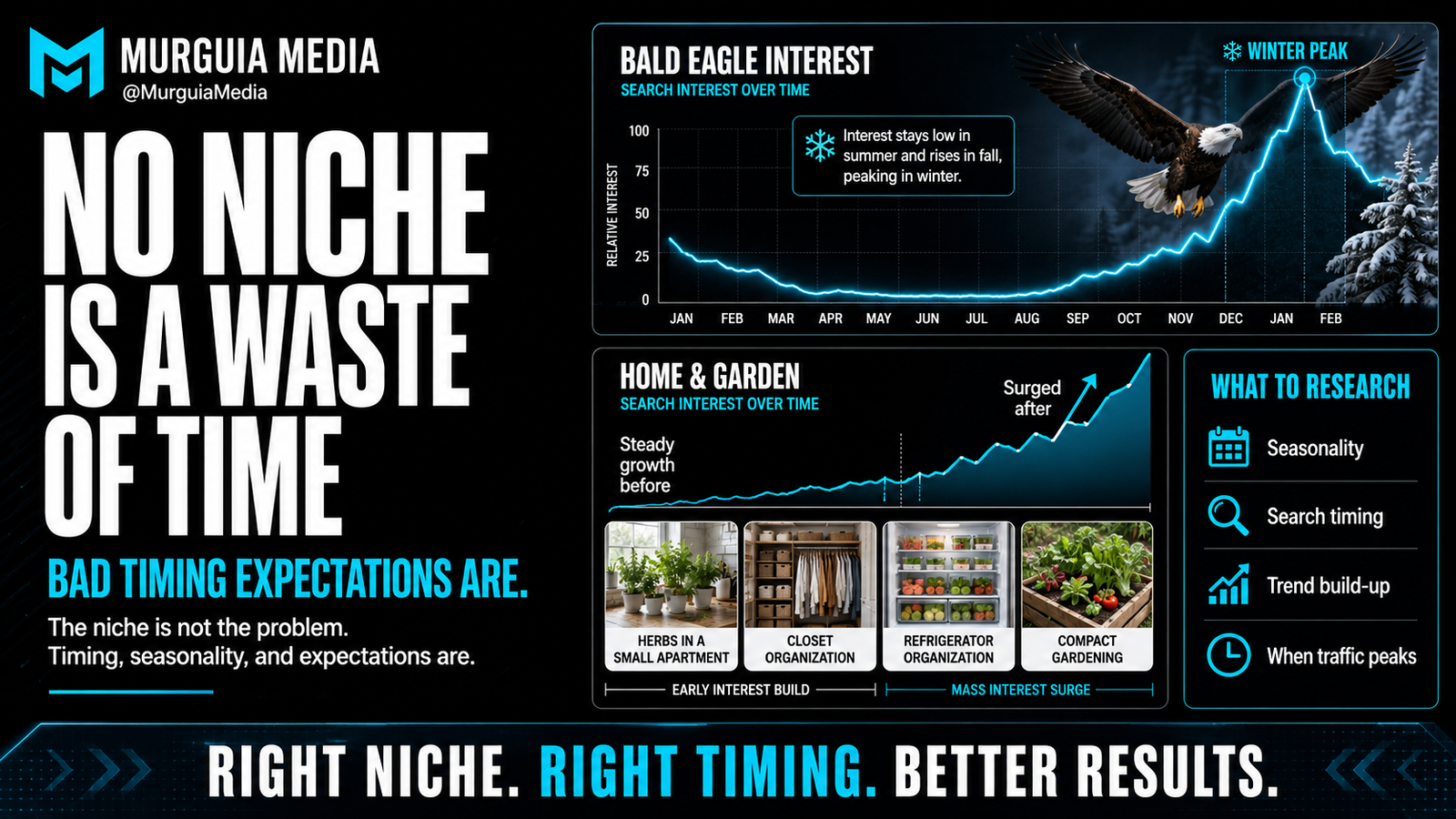
No Niche Is a Waste of Time. Bad Timing Expectations Are.
I don’t believe any interest or niche is inherently a waste of time. If it genuinely interests you and you want to build something long-term around it, that’s worth pursuing. What actually wastes your time is chasing results before you’ve done the basic research into when those results are supposed to show up.
Here’s an example that makes this obvious. Let’s say you’re interested in bald eagles. Bald eagle mating season is in the winter. If you start posting about that in the middle of summer expecting a wave of traffic, you’re going to be disappointed — not because the niche is bad, but because you’re asking for results before the season that actually drives interest has even arrived. The traffic isn’t gone. It’s just not time yet.
A Bigger Example: What Happened to Home and Garden Content Before and After COVID
I want to give you a real, larger-scale example of timing, because it shows how far this actually goes. Before COVID hit, home and garden content was already building steadily on Pinterest. People, especially in small city apartments like in New York, were sharing how they grew their own herbs in tight spaces. Chefs and home cooks were leaning into organic and clean living. Closet organization and refrigerator organizing content was already picking up steam too. People were sharing what they genuinely did at home, tied to a blog, an affiliate account, or ad revenue. There was already a real purpose behind it.
Then COVID hit, and those exact searches exploded. Suddenly stores weren’t a guaranteed option. People needed to know how to clean their homes properly, how to organize the space they were now living in full-time, and how to grow their own food, right as seeds themselves became hard to find. All of that content that had been quietly building before the world changed was already sitting there, ready and indexed, right when the demand surged.
Nobody planned for a pandemic. But the people who were already consistently building home and garden content on Pinterest before it hit were positioned to catch that wave the moment it arrived. That’s what understanding timing and staying consistent actually protects you for — not just the seasons you can predict, but the demand you can’t.
Your Content Doesn’t Expire on a Fixed Timeline
I’ve seen it said that a pin’s relevance runs out after about a year. Based on what I’ve experienced myself and confirmed researching this further, that’s not accurate. Pinterest content commonly keeps generating traffic for months, and strong pins keep performing for years — some of the best-performing pins out there are still driving clicks nearly a decade after they were first posted. Pinterest search doesn’t work like a single news cycle. It keeps resurfacing content as long as people are still searching for it.
I can show you this directly from my own account instead of just telling you. One of my BeautyGenX pins was created back in August of 2024 — over a year ago now. In just the last 30 days alone, that single pin has pulled in 1.53 million impressions, 57,260 pin clicks, and 5,820 saves. That’s not a pin coasting on old momentum. That’s a year-plus-old pin still performing at full strength, right now, today.
This matters because it changes how you should think about “wasted” effort. A pin you make today isn’t racing against a countdown clock. If the keyword is right and the content holds up, it can keep earning for you long after you’ve moved on to other things.
Why Pinterest Is Worth the Effort While It’s Still Free
Here’s something else worth understanding about timing and where to put your energy. Google is enormous — you’re competing against nearly everyone publishing online, and unless you’re paying for ads, which can get expensive fast without guaranteeing results, ranking organically takes real time and real authority to build. Pinterest works differently. It has a smaller pool of content competing for the same searches, and it sends notably specific, intent-driven traffic — people who are actively looking for exactly what you’re offering, not just casually browsing. That combination, still largely free to build on, makes it one of the more valuable places to be putting consistent effort right now.
The Real Risk Is Lying to Yourself
When I say something is a waste of time, I don’t mean the topic. I mean giving yourself false expectations and then treating those expectations as fact. Be realistic about when you’re starting, what you’re putting out, and when it’s actually reasonable to expect a response. Second-guessing yourself against a timeline that was never accurate to begin with is how people quit right before something would have started working.
You Can’t Know Your Audience Until You Have Your Own Traffic
This connects to something I mentioned earlier in this series about looking at other creators for calibration. That’s useful, but there’s a limit to it. Watching someone else’s account tells you about their audience, not yours. You can get an idea from it, but actually knowing your own audience requires you to get your hands dirty with your own real traffic. There’s no shortcut around that part. It’s a learning process, and it only starts once you’re actually live.
Bilingual Content Is a Lane Most People Skip
Here’s something worth testing that most beginners never think to try: Pinterest will translate your content into Spanish, and that market is enormous. I run a blog with both English and Spanish posts, and both languages pull in solid, real traffic. If your audience or your interest naturally crosses into a second language, that’s not extra work for no reason — it’s a second lane of search traffic sitting right there, mostly untouched by people who never think to use it.
Your Best Tool If You Can’t Afford a Coach: AI, Used Deliberately
If you can’t afford a paid coach or mentor, AI is genuinely the next best thing — but only if you use it the right way. Don’t just grab the first tool and assume it’s the one. Take the same set of real questions and run them through a few different AI tools. See which one actually gives you answers you can use, and more importantly, which one you actually understand and relate to. Try the voice features too, if they have them — sometimes how a tool talks to you matters as much as what it tells you.
This isn’t wasted research time. This is exactly the kind of research that keeps you from wasting time later, because you’ll be working with a tool that actually fits how you think, instead of fighting one that doesn’t.
Bringing These First Five Parts Together
Across these five parts, the throughline has been the same: Pinterest rewards people who understand it as a search engine, get organized before they have proof, protect real time to build without ignoring what they’re already noticing, read their numbers with a clear eye, and stay realistic about when results are supposed to arrive — including the bigger, unpredictable timing shifts that reward consistency more than perfect planning.
None of it is complicated. Most of it is just patience, paired with actually doing the research instead of skipping straight to posting. And if you’re already selling on other platforms, there’s more still — Part 6 of this series picks up exactly there.