6 YouTube Creator Facts You Need to Know in 2026
Posts claiming that YouTube has completely changed its algorithm spread quickly. They often use phrases such as “breaking update” or “everything creators knew is now wrong.” Some of the information may be accurate, but important qualifications are frequently left out.
For creators, that missing context matters. Changing your content strategy based on an exaggerated social media post can waste time, confuse your audience, and cause you to abandon practices that were already working.
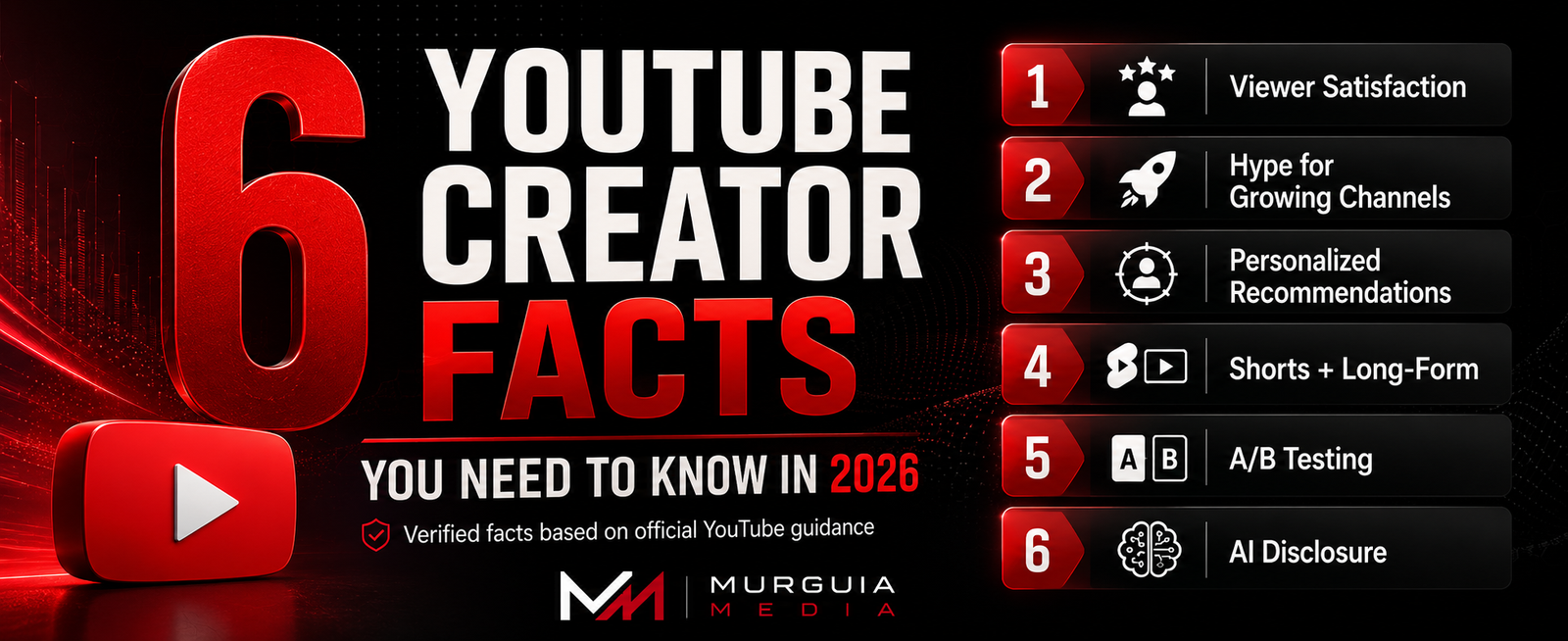
Here are six YouTube creator facts worth knowing in 2026, based on official guidance published by YouTube.
1. Viewer Satisfaction Matters, but Watch Time Still Matters
YouTube does not rely on one signal when deciding which videos to recommend. Its recommendation system considers several kinds of viewer activity, including watch history, search history, likes, dislikes, subscriptions, feedback, satisfaction surveys, and watch time.
Satisfaction surveys help YouTube understand whether viewers felt that a video was worth watching. This gives the platform information beyond how long someone remained on a video. However, satisfaction has not simply replaced watch time.
Watch time remains important. YouTube also uses watch time when evaluating the results of its title and thumbnail A/B testing feature. For creators, the lesson is not to make every video longer. The goal is to create a video that fulfills the promise made by its title and thumbnail.
A shorter video that answers the viewer’s question clearly may perform better than a longer video filled with unnecessary information. Focus on making viewers feel that clicking your video was worthwhile.
2. YouTube Hype Can Help Eligible Growing Channels
Hype is a real YouTube feature designed to support growing creators. It is available to eligible channels in the YouTube Partner Program with between 500 and 500,000 subscribers.
Viewers can Hype qualifying long-form videos during the first seven days after they are uploaded. Hyped videos can earn points and may receive additional visibility through country-specific leaderboards.
The feature is only available in supported countries, and not every video or channel will qualify. Creators who have access to Hype should pay close attention to the first week after publishing a long-form video.
That is the time to announce the video through Community posts, email, social media, and other places where existing supporters can find it. Hype does not replace a strong topic, title, thumbnail, or video. It gives eligible channels another opportunity to encourage early support and discovery.
3. The YouTube Home Feed Is Personalized
The YouTube homepage is different for every viewer. YouTube says Home recommendations rely primarily on each person’s watch history. Search history, subscriptions, likes, dislikes, and direct feedback can also influence what appears.
This means that two people interested in the same general subject may still receive very different recommendations. Someone who regularly watches beginner home-decor videos may see different content from someone who watches professional interior-design tutorials.
This is why creators benefit from knowing exactly who a video is intended to help. A broad title such as “Tips for Growing on YouTube” does not identify the viewer clearly.
A more specific title, such as “YouTube Growth Tips for Small Faith-Based Channels,” communicates both the subject and intended audience. Specific content helps viewers recognize that a video is relevant to them and gives YouTube clearer information about who may be interested in watching it.
4. Posting Shorts Does Not Hurt Long-Form Recommendations
Many creators worry that posting Shorts will damage the performance of their long-form videos. YouTube says Shorts performance does not negatively affect long-form video recommendations.
The platform evaluates individual pieces of content and attempts to match each one with viewers who are likely to enjoy it. YouTube may also use a viewer’s interests across Shorts, long-form videos, livestreams, and posts to inform recommendations across different formats.
However, this does not mean every Shorts viewer will become a long-form viewer. Someone may enjoy a 20-second tip but have no interest in watching a 20-minute video. That reflects the viewer’s preferences, not necessarily a penalty against the channel.
Creators should use Shorts with a clear purpose. A Short can introduce a topic, answer one quick question, highlight part of a longer video, or help a new audience discover the channel. Shorts and long-form videos can exist on the same channel without automatically harming one another.
5. Eligible Creators Can A/B Test Titles and Thumbnails
YouTube allows eligible creators with Advanced features enabled to test up to three titles, thumbnails, or title-and-thumbnail combinations. This gives creators a way to compare different versions instead of guessing which one will perform best.
YouTube evaluates the test using watch time, not only click-through rate. That distinction is important because a dramatic title or thumbnail may attract more clicks but still perform poorly if viewers leave quickly.
The best title and thumbnail should attract the correct audience and accurately represent the content. Creators can test a direct title against a curiosity-based title, a person-focused thumbnail against an object-focused thumbnail, or a close-up image against a wider scene.
Testing nearly identical designs may not provide useful information. The goal is not simply to receive the most clicks. The goal is to attract viewers who are likely to continue watching.
6. Realistic AI-Generated Content May Require Disclosure
YouTube requires creators to disclose content that has been meaningfully altered or synthetically generated when it appears realistic. This may include making a real person appear to say something they never said, altering footage of an actual event, or creating realistic footage of something that never occurred.
The policy focuses on final content that could mislead viewers. Using AI to brainstorm ideas, organize research, develop an outline, write a draft, create captions, or assist with basic editing does not automatically require an AI disclosure label.
The important question is whether the finished content could cause viewers to believe something real happened when it did not. When realistic or meaningfully altered AI material appears in a finished video, creators should use YouTube’s disclosure setting during the upload process.
Disclosure does not replace other YouTube rules. Videos must still follow copyright policies, Community Guidelines, impersonation rules, and monetization requirements.
What These Facts Mean for YouTube Creators
These six facts do not reveal a secret shortcut to instant channel growth. They show that YouTube continues to focus on matching individual viewers with content they are likely to choose, watch, and enjoy.
A strong YouTube strategy still depends on understanding the intended viewer, choosing a clear topic, creating an honest title and thumbnail, and delivering the value that was promised.
Hype may provide extra visibility. A/B testing may improve how a video is presented. Shorts may help new viewers discover a channel, and AI tools may make production faster. None of these tools, however, can replace useful, engaging, original content.
Final Takeaway
Creators should be cautious when a viral post claims that YouTube has completely changed overnight. Some of the information may be real, but eligibility requirements, limitations, and important context are often removed.
Before changing your channel strategy, check the official YouTube Help Center and confirm exactly how a feature works. YouTube will continue to change, but the central principle remains the same: create content for a clearly defined audience and make the viewing experience worth their time.